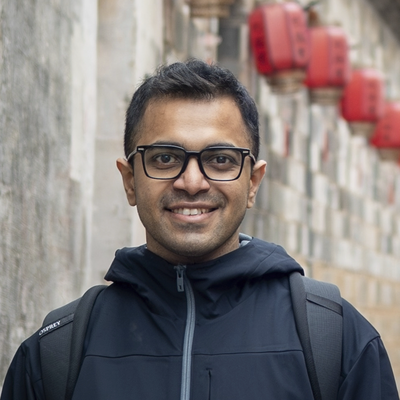
Hi! I'm Sanjay ...
I am an AI researcher working on multimodal learning, synthetic media analysis, and human-centred decision support. I am a Post-doctoral Research Fellow at the Augmented Human Lab (AHLab), National University of Singapore (NUS), where I build context-aware multimodal Small Language Model (SLM) interfaces and explainable Human-AI Interaction systems for real-time decision support in high-risk scenarios. I also serve part-time as a Founding Engineer at NexZ, building an enterprise AI engine for workflow automation.
Previously I spent two years at TikTok (ByteDance) as a Machine Learning Engineer in Content Intelligence, shipping large-scale video deduplication and real-time moderation systems for TikTok LIVE. I hold a PhD in Computer Science from NUS (2024), with a thesis on digital face synthesis and deepfake analysis.
Education
PhD Computer Science
2019 – 2024
National University of Singapore
MS Computer Science and Engineering
2015 – 2016
University of Dhaka
BS Computer Science and Engineering
2010 – 2014
University of Dhaka
Research Interests
- Oct 2026 — Served as a reviewer for the BMVC 2026 GlobalSouthCV workshop.
- Sept 2026 — Invited talk, Multimodal AI, at Brac University.
- Sept 2026 — Served as a reviewer for the NeurIPS 2026 GlobalSouthAI workshop.
- Aug 2026 — Paper accepted at the ACM MM 2026 IMPACT workshop.
- Aug 2026 — Served as a reviewer for the ACM MM 2026 IMPACT workshop.
- Jul 2026 — Invited talk, Multimodal Video and Image Understanding, at Curtin University, Australia.
- Jun 2026 — Invited talk, Facial Deepfake Detection in the Open-Set Paradigm, at the CVPR 2026 PPMisDet workshop.
- May 2026 — Joined the Augmented Human Lab at NUS as a Post-doctoral Research Fellow, after two years at TikTok.
Show earlier news
- 2026 — Two papers accepted at ACM SIGKDD 2026 — one in the main proceedings on dynamic content moderation in livestreams, one in the Applied Data Science track on large-scale video deduplication.
- 2026 — Nostalgic appeal in prosocial deepfakes of deceased and living artists accepted at Behaviour & Information Technology.
- 2026 — Resurrecting historical figures: The persuasive power of deepfakes versus text-based first-person narratives accepted at Mass Communication and Society.
- 2026 — Beyond deepfake vs real: Facial deepfake detection in the open-set paradigm published at the CVPR 2026 workshops.
- Nov 2025 — Joined NexZ as a part-time Founding Engineer, building an enterprise AI engine for workflow automation.
My research explores the intersection of computer vision, multimodal content understanding and biometric security. During my PhD at the National University of Singapore, I developed algorithms to assess AI-generated content (AIGC) while also conducting interdisciplinary studies on how manipulated media impacts audience perception and digital literacy.
My academic works published in top-tier venues like ICCV, KDD, and Pattern Recognition, are deeply driven by practical, real-life AI/ML challenges. At TikTok, I translated these foundational research ideas into production-scale multimodal AI systems, designing robust computer vision and retrieval pipelines to safeguard high-volume livestreaming environments. I now build multimodal small language model interfaces and explainable human-robot interaction systems at the Augmented Human Lab, NUS.
Feel free reach out to collaborate 😃
I’ve spent over eight years teaching across multiple universities, and I’m deeply passionate about making complex technical subjects accessible and engaging. My teaching journey has taken me through roles as an Assistant Professor, Lecturer at UIU and UAP (Dhaka), and Graduate Teaching Assistant at the National University of Singapore (NUS).
Along the way, I’ve taught a wide variety of classes, everything from foundational algorithms and programming to advanced applied machine learning. I really enjoy breaking down advanced AI concepts for inter-disciplinary cohorts, making sure students from all backgrounds feel confident tackling the material. I also place a heavy emphasis on personalized mentorship, and one of my favorite experiences has been guiding undergraduate research groups through to their first peer-reviewed publications.